Special Educational Needs

Child's hands holding a pencil and coloring on graph paper with numbers and grids.

An inclusive education...

We are an inclusive school committed to giving all our pupils every opportunity to achieve the highest of standards.

We provide education for all pupils through a variety of access strategies and the provision of resources and facilities as necessary.

All pupils' needs are considered and a range of flexible responses are available to accommodate and value their diversity.

When necessary we support learning through appropriate external specialists, tailored to individual need.

How we support SEND at Loughborough

Our SENDCo

Grace Maguire is currently on maternity leave. Her role is being covered by Lilian Koder until the end of this academic year (July 2026). Our SENDCo coordinates provision for all children with additional needs, liaises with external professionals, keeps parents fully informed, and ensures our SEND Policy is implemented consistently across the school.

Contact via the school office on 020 7274 8374

Our SEND Governor

Myrtle Charles is our SEND Governor and sheensures the school's SEND report is up to date, that appropriate provision and adaptations are in place, and that SEND funding is used appropriately. Contact via the school office.

Loughborough Primary School is a mainstream school and part of The Charter Schools Educational Trust (TCSET).  We have classes of up to 30 children led by a class teacher.  Through a 3-tiered approach to SEN support (See SEN Provision section), we make all reasonable adjustments possible to support a range of special educational needs (SEN)across 4 broad areas:

Cognition and Learning (C&L):

This might include difficulties with reading and spelling, learning new information and concepts, working with numbers, working memory and concentration. Such difficulties might include ‘Specific LearningDifficulties’ (i.e. dyslexia, dysgraphia) and moderate learning difficulties.

Communication and interaction (C&I):

Difficulties might include understanding or using language and communicating socially with others.  This might include conditions or disorders such as: Specific language impairment, autism (ASD/ASC) and speech sound disorders/delay.  

Social, Emotional and Mental Health (SEMH):

This might include difficulties such as experiencing trauma, anxiety, stress, distress or anger that have an impact on accessing education.

Sensory and/or physical (S/P):

This might include sensory processing differences affecting movement and co-ordination, physical disabilities, sensory sensitives and sensory impairment (i.e. Hearing Impairment)

It is common for children to have special educational needs that span two or more of these areas.  If this is the case, SEND support is designed to best support your child’s need using the resources available.

For your child to access the best possible support, it is important that SEND differences are identified early through appropriate methods of assessment.  At Loughborough, our objective is to understand exactly what support individual children require using age and stage appropriate strategies.

Dependent on a child’s specific areas of need, assessment can take place in many ways, through different members of staff or external professionals (for example, Educational Psychologist, Speech and Language therapist and community paediatrician). Assessments and screening activities are always developmentally appropriate and we work closely with families to agree assessment methods.

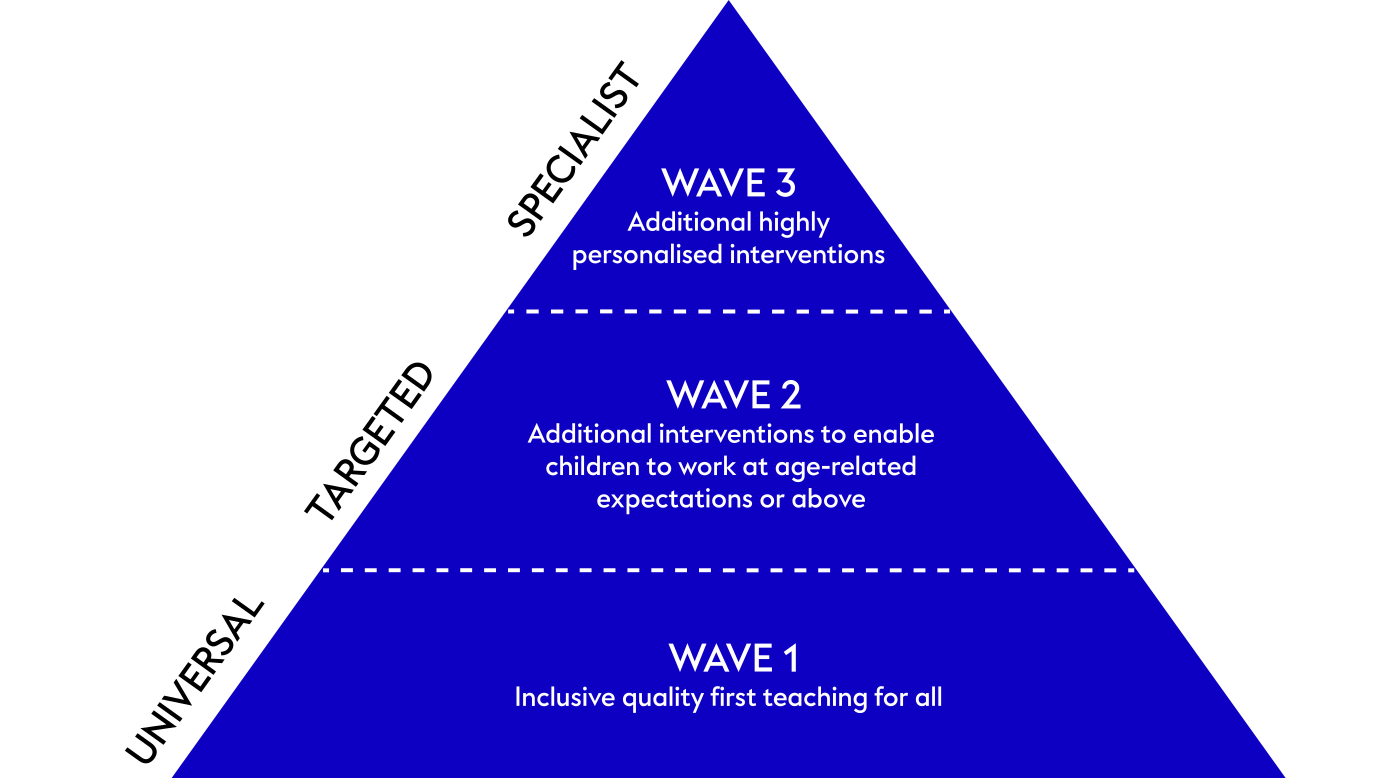
At all Charter Schools, we have a 3-tiered approach to SEND support across the school. Depending on children’s strengths and differences, support will look different for individuals.  

Wave 1 – Universal Support

Our first priority is to ensure the highest standard of inclusive teaching possible for all children, using of range of evidence-informed strategies. This forms Wave 1, of our 3-tiered SEND offer.  


This level of support will involvea range of strategies including a 5-a-day model of inclusive teaching:

1.     Precise instruction and explanation

2.    Supporting children to develop independent thinking and learning strategies

3.    Effective visual, verbal and written ‘scaffolds’ to enhance access to learning.  

4.   flexible grouping of children

5.   effective use of technology


Wave 2 – Targeted Support

For children who require a more personalised approach to specific areas of learning, in addition to the Wave 1 strategies, children may have access to group-based interventions. These sessions, run by SEND learning support assistants or teachers, include support for differences across the 4 broad areas of need such as: speech and language, specific literacy and mathematical skills, social skills, physical and sensory development and emotional literacy. Wave 2 support aims to enable children to make accelerated progress against their targets and to be working at the age-expected level.

The interventions vary term on term according to need and resources. The school SENDCo can provide information on current interventions on request as available interventions are subject to regular change according to pupil need and available resources.

Wave 3 – Specialist Support

For a small number of children, a highly personalised approach to learning is required, using recommendations from external professionals such as a speech and language therapist (SaLT), Educational Psychologist (EP) or specialists from other services. This type of support will vary hugely between individuals dependent on strengths and differences.  Children who might benefit from Wave 3 support will often have or require an Education, Health and Care Plan (EHCP) in order for the school to provide the level of specialist support.


All support across the school is monitored and evaluated termly. This is to ensure that the support in place is meeting the needs of individual children.

For your child to access the best possible support, it is important that SEND differences are identified early. At Loughborough, our objective is to understand exactly what support individual children require. Dependent on a child's specific areas of need, assessment can take place in many ways — through class teachers, the SENDCo, or external professionals such as an Educational Psychologist, Speech and Language Therapist or community paediatrician. We work closely with families to agree assessment methods.

How we work with parents

We believe you should be fully involved at every stage of the SEND process, from initial identification through to decisions about support in school. This follows the Assess, Plan, Do, Review (APDR) model. Communication between school and parents is two-directional.

If your child's teacher has concerns, they will speak to you to ask for your thoughts and input. If you have concerns, speak to your child's class teacher in the first instance — they will give you feedback on how your child is progressing and you can develop a support plan together.

How is my child doing?

Your child's class teacher monitors progress continuously across reading, writing, numeracy, attendance, engagement and social and emotional development. Children receiving SEND support will have an Individual Education Plan (IEP) or SEND Support Plan, reviewed every term with your involvement.

For children with an EHC Plan, progress is reviewed at an Annual Review meeting with input from all professionals involved, as well as from you and your child.

We keep you updated through home/school contact books, letters, additional meetings, annual reviews and end-of-year reports. Parents' evening takes place termly and is a key opportunity to discuss progress and shape the support planned for the coming term.

Is Loughborough the school for my child?

We pride ourselves on providing high quality SEND support through our tiered approach. We work with Lambeth Local Authority and across the Charter Trust network to provide the best possible support for children with a wide range of needs.

For children who require a very high level of specialist support, it can sometimes be difficult for complex needs to be fully met within a mainstream setting. If you feel this might be the case for your child, please contact the SENDCo to discuss provision.

How will teaching be adapted for my child?

Class teachers plan lessons to meet the specific needs of all children. They will adapt learning tasks so your child can access their education as independently as possible, and will adjust their planning every day as needed. Trained support staff help implement modified lessons, and specific resources and strategies will be used individually, in small groups, or within the classroom.

How will my child be supported when starting school or moving classes?

We will invite you and your child to visit the school, tour the facilities, and meet key staff before they start. If other professionals are involved, we will arrange a Team Around the Child (TAC) meeting to ensure the right provisions are in place.

When moving between year groups, your child will meet their new teacher in advance and all relevant information — including IEPs and EHCPs — will be passed on before the move takes place.

In Year 6, our SENDCo contacts the SENDCo at your child's new secondary school directly to ensure additional support is in place from day one.

How do I raise a concern?

Speak to your child's class teacher first. If you feel your concerns aren't being addressed, speak to the SENDCo or Headteacher. If you are still not satisfied, contact Myrtle Charles, our SEND Governor, via the school office.


For some children, universal and targeted support (Waves 1 and 2) are not enough to enable them to learn most effectively. For children with more complex or significant needs, an Education, Health and Care Plan (EHCP) may be necessary. This is a legal document that describes a child's special educational, health and care needs, the support they require, and the agreed outcomes to be achieved.

An EHCP can only be issued after an EHC needs assessment has been completed. This can be requested by the school or by parents.

For more information specific to Lambeth, visit the Lambeth SEND Local Offer.

As a school in Lambeth, we work actively with the local authority and health services to ensure education, health and care services for children with SEND are joined up.

  • Lambeth SEND Local Offer
  • Lambeth Information, Advice and Support Service (LIASS)
  • DfE SEND Code of Practice
  • SEND Team at Lambeth

f your concerns have not been resolved by the SENDCo or Headteacher, please follow the school's Complaints Procedures Policy, available from the school office.

For independent advice and support, contact the Lambeth Information, Advice and Support Service (LIASS):

Our policy is to work actively to support cooperation between local  authorities and health services, to ensure education, health and care  services for children with special educational needs and disabilities are  jointly planned and commissioned.
 
Further information about support and services for pupils and their families can be found below.


Lambeth local SEND offer


Special Educational Needs and Disability Team Lambeth


DfE SEND Code of Practice